Monday, May 23, 2011

Peru's Sacred Valley and Machu Picchu

With much anticipation, we embarked on our adventure to the heart and soul of the Incan Empire, and the pride of their construction abilities - towards Machu Picchu.  On the way, we stopped at several towns and sights of other ruins. 


This church on the edge of Chinchero, north of Cusco, was built on the foundations of an Incan settlement in the 1600s.  It is very simple compared to many other colonial churches - no guilding or fancy tapestries or scultptures - very plain, but one of the most beautiful we've seen on the trip.  The very simple colours, the mosaic ceiling, the rural location all made for a beautiful and peaceful setting. 


Just outside the church, the misty morning made for a mystical Sacred Valley view.


This unique structure at Moray was an Incan farming laboratory where they experimented with different crops on different terraces and altitudes.  It was quite large, and quite a uniqe place.


Just outside of Urubamba, a small spring flows from the side of a mountain.  This spring is full of salts and minerals, and the Incas created the terraces below to farm the salt by creating hundreds of little waterways to fill the plots, and then divert the water elsewhere until the salt could be harvested before refilling the plots - incredible...


We reached Machu Picchu in the afternoon,  andeven after all of the build up from everyone saying how incredible it is, we were struck by the magnitude of the place.  The stone work, the terraces, the scenery - all just amazing.  It was just incredible that they built this massive city on such a precarious perch, but the view explains all the hard work that went into it - just amazing.


Around the corner, about a 1km walk from the main structure is this Inca Bridge, which was part of the Inca Trail in the old days.  Many beautiful flowers and views of the Urubamba River kept our attention as we meandered to this wooden bridge that was one of the few safeguards of the site.


Back at the main site, the Temple of the Sun - where most of the worship and sacrifices took place, was a unique structure where the priests ruled.

Peru! Lake Titicaca and Cusco

After a wonderful time in Bolivia, we took a bus ride from Copacabana, Bolivia across the border to Puno, Peru. 

The town of Puno was quite...simple...and not the cleanest place.  However, we did find some wonderful deals on souvenirs!  This town, however, is the place from which to explore the Peruvian side of Lake Titicaca, and we spent a morning on Isla de Uros - an island community where the islands are made entirely of reeds that grow in the lake.  They form a floating foundation from the roots, and pile fresh reeds on regularly.  People have been living here this way for hundreds of years, but mostly now it's a show for us gringos with songs, trinkets, solar panels and television sets.  Never the less, it was still interesting to see how a group of people lived on straw for many years.


Onward to the city of Cusco, which was the centre of the Incan Empire for several hundred years.  The downtown area is filled with Colonial era buildings that are built on foundations of Incan structures that were torn down by the Spaniard conquerors.  It's a beautiful city with an incredible $5 Indian buffett, a museum with a very unique collection of nativity scenes, one made of doilies, one of bent forks and spoons, one of animal bones, and so on.  The cathedral houses a very unique painting of the Last Supper, with the drink on the table being Chicha, a local corn-based moonshine, and the food on the table being a local rodent - Vizcacha - a member of the chincilla family that looks like a rabbit but has the tail of a squirrel - very entertaining. 


A fountain in Cusco's main square.

One Incan building that was partially preserved was the Temple of the Sun.  While a convent was built overtop of it, much of the structure remained and was restored - the stone work is incredible.


Two months ago, a chocolate museum was opened in Cusco to help educate and create a local market for the many cocao producers in Peru (which is the second largest producer of cocao beans in South America).  They also offer seminars on how chocolate is processed and made, so of course, we did the 2-hour session.  We roasted beans, crushed them, melted it down and ended up with some yummy yummy treats that lasted a few days :o)

Sunday, May 8, 2011

Tail end of Bolivia...La Paz and Lake Titicaca

The city of La Paz.  A bustling, vibrant, hilly city!

A sample of goods at the Witche's Market.  This is what somebody would typically buy and burn as an offering to Pachamama (Mother Earth), a practice common among Andean cultures.  Yep...that's a llama fetus in there!

The Gate of the Sun, at Tiwanaku.  This is an important archeological sight outside of La Paz, built by a pre-Incan culture called the Tiwanakus.


The bustling town of Copacabana on Lake Titicaca.  It was a national holiday, so all the city folk were in town for the weekend...normally this beach was empty!
View from the top of Isla del Sol on Titicaca.  It was a hell of a hike up...@ 4100 meters above sea level.  Seriously...sea level, I miss you with your oxygen-rich air.

This marks the end of our time in Bolivia...three weeks in total.  It was my favourite country we've been to so far.  Some people I've told have been surprised by that...but it's a really special place.  The landscapes are so varied and unique.  The people, though some are devistatingly poor, are dignified and proud.  There is so much culture and history here, evident everywhere you go, it makes for a fascinating place to visit.

Thursday, May 5, 2011

Bolivia - Part 2 - Potosi, Sucre and Samaipata

After the salt flats, we continued eastward to the town of Potosi. After silver was discovered here in the 1500s, the town became the wealthiest and largest in the world - even more important than Paris and London at the time.


Many people work in 3 shifts around the clock in this mine, closest to town - the typical worker earns between $4.50 to $10 per day with an average life expectancy of 35.  The local market closest to the mine supplies the employees with their daily needs of coca leaves, clothing, flashlights, and dynamite...the sale of which is completely unregulated in this town only - we could have bought it if we wanted!


The town of Sucre is the constitutional capital of Bolivia, and birthplace of the Bolivian nation.  Many museums and lots of history - a very nice and relaxing town to have spent the Easter holidays.  The bonus to everything was the prices - we bought lunch for both of us for under $5!


One of the most incredible parts of the trip so far was the rock quarry where dinosaur footprints were discovered a few years ago.  The area is not under the constant study of palaeontologists and one can see - literally - thousands of dinosaur footprints from 60million years ago - mind boggling...


From Sucre we flew to the tropical east of Bolivia and ended up in Samaipata - one of the historical centers of the Incan empire, where the Incan empire traded with the tribes from the Amazon.


El Fuerte was carved by an Amazonian tribe that pre-dated the Incas - at least 700 years go.  The hill is sandstone, and the site was carved right into the mound.  It was later taken over by the Incas, and after that, the Spanish Conquistadors.


The following day we went for a hike up a considerable verticle incline to find a cave with some old, but unidentified paintings.


On the way down, we decided to take a picture with a very unique local cactus - ouch!


Bolivia - Part 1 - The Salt Flats

After a wonderful 3 weeks in Bolivia, we finally found some time to update the blog!  Our first stretch of Bolivia was crossing the border from Chile, crossing the Altiplano, going through the Salt Flats, and making our way towards the center of the country. 

The first taste of Bolivia was the border crossing - basically a dirt line with a 150 sqft shack as the control point.  It was an interesting, and very unique experience! 


As we continued on, we passed several lakes infused with various minerals that changed the colour of the water - red, green, blue, white - all very beautiful.


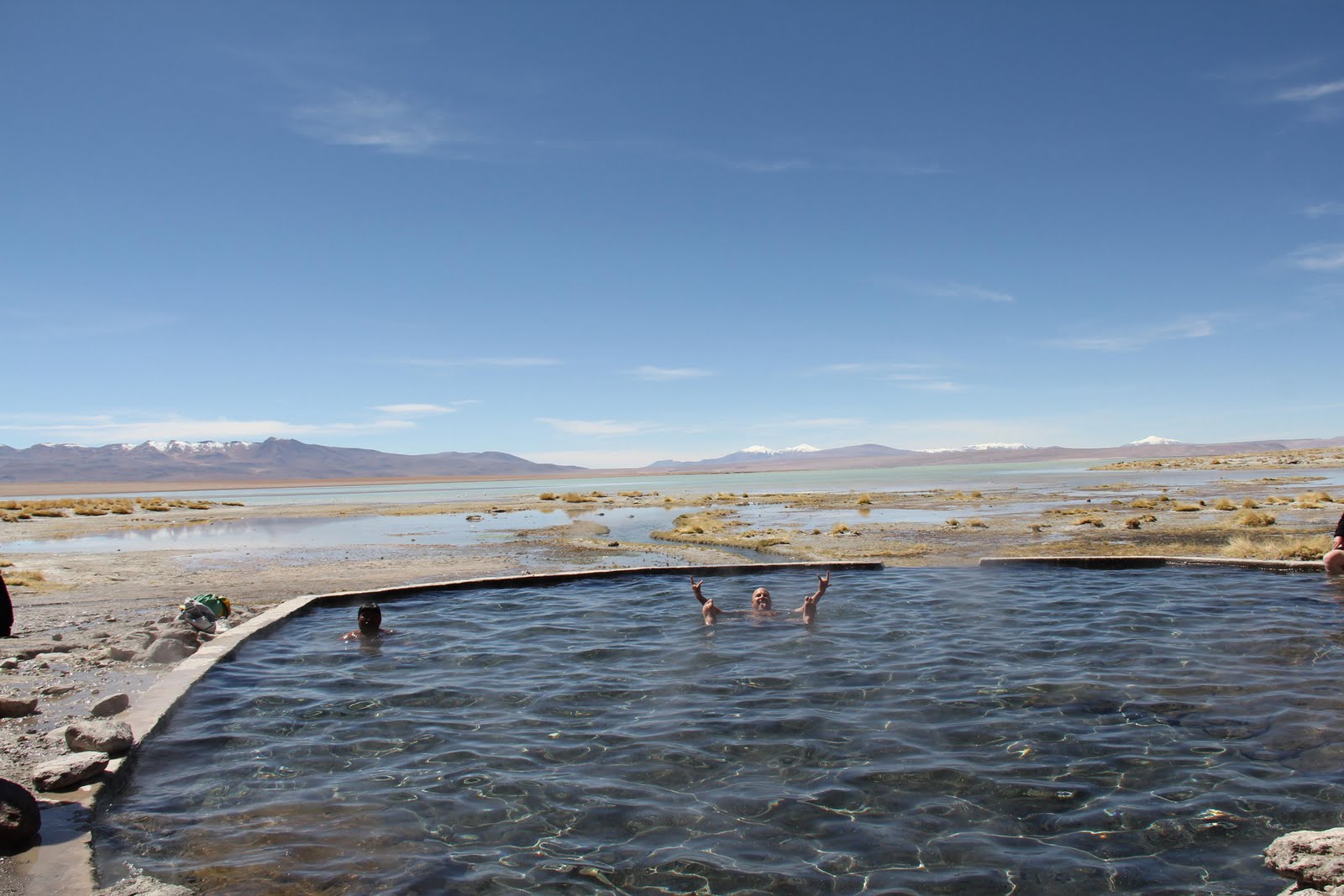
Our first non-photo-op stop was a natural hot-spring with a view of the snow-capped mountains in the background.  We stayed in until our fingers pruned - luckily our timing was good as about 2 dozen people showed up as we were getting dried off! 


After lunch, we stopped at the Red Lagoon which is home to thousands of pink flamingos. One of the most incredible parts of this area was that on our walk, we found fossilized coral, which was neat, until we realized that we were at 4,000+ meters above sea level - that just messed with our heads...incredible...


We stopped at Rock Valley for a goofy photo-op.


The next day, we visited the Uyuni Salt Lake - over 10,000 sq km and visible from outer space!  Becuase of the reflection, we both got quite the sun-tans, and were just amazed at the incredible sight.  The most difficult part of the trip was watching dozens of vehicles with people shovelling the salt into the open backs of trucks for transport back to the nearest town.  Here, they process the salt and sell it for about C$2 for 15kg...a very hard life...


We spent that evening in one of several salt hotels at the edge of the lake - the bricks, the floors, and most of the furniture - all made of salt...just amazing! 

Saturday, April 23, 2011

San Pedro de Atacama, Chile

After departing Argentina, with high hopes of finding better food, we made our one and (sadly) only stop in Chile...in the desert!  We took a long bus ride to get there...and found some relief from the tediousness of it in the form of a lovely new Aussie friend, named Jamie, who we ended up spending loads of time with once we arrived!
San Pedro was a delightful little town...adobe houses, unpaved, dusty roads...sadly no tumbleweed, though.  There are a large number of hippie tourists who arrive there and decide not to go home...which translates into some really good veggie food options (yay!!!).  The scenery was incredible, the history fascinating, and the energy of the place was really something special!
The best moments came care of a tour that we did, with the aforementioned Jamie, and another Aussie friend Caroline.  We hired a private guide, at a cost remarkably similar to what we would have paid for a 'sheep tour'.  Our guide Dan was an absolute delight...well-informed, spoke perfect english, recited a monologue from Braveheart upon request...you get the picture! 
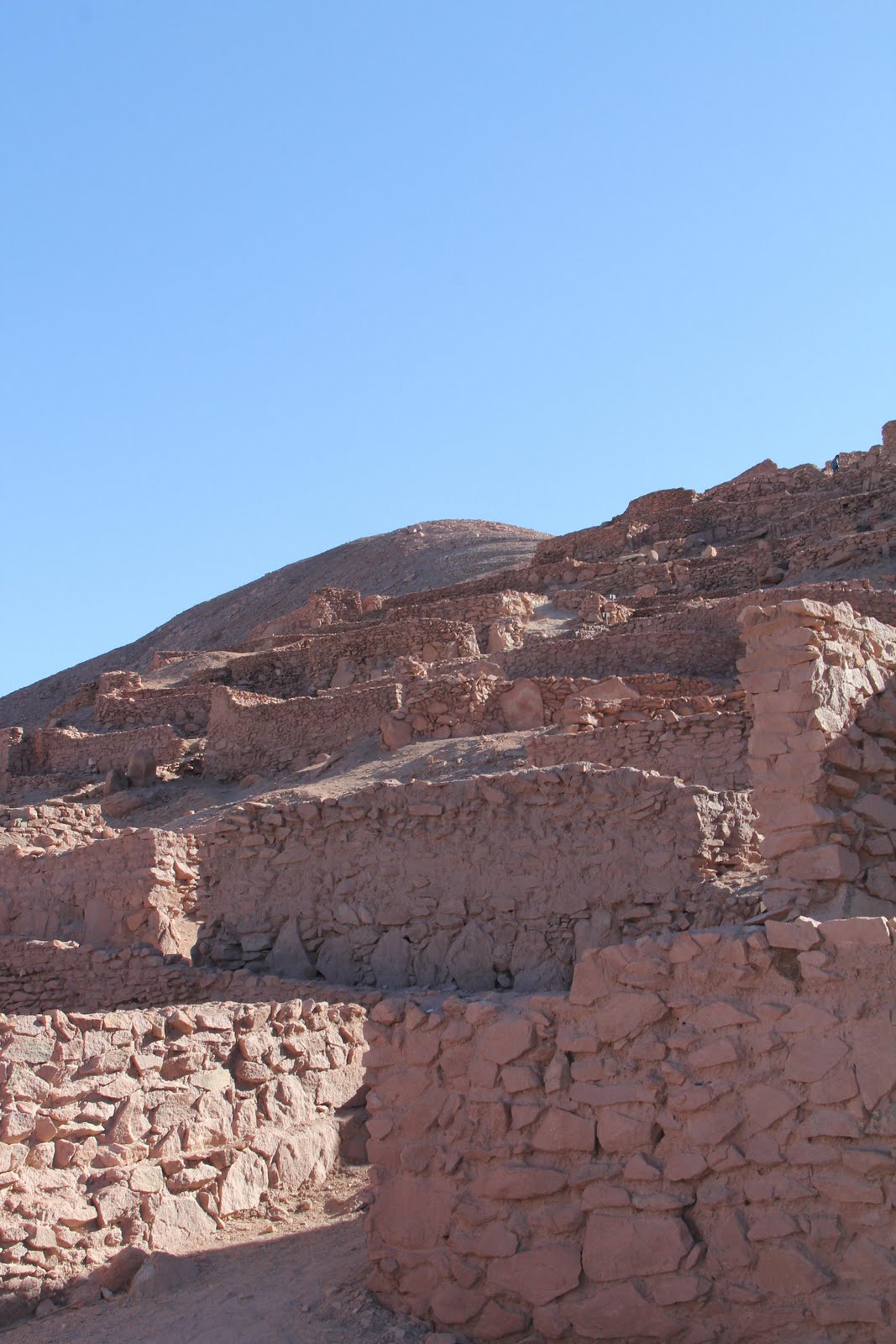
We were treated to some amazing archeological sights, as well as the Valley of the Dead (an unfortunate name for a really, really beautiful place).  At days' end we found oursleves atop a mountain watching the sun set over Valley of the Moon, with a wonderful bottle of Mendoza red...one of those aaaahhhhhh kind of moments.
As we trekked back down the mountain I saw an opportunity to satisfy a burning urge I'd had all day...to make a sand angel in the dunes!  With the Fun Police out of sight around a bend, I leapt from the marked trail, threw myself down (on the surprisingly hard sand), and flailed away in all my glory...so satisfying :o)


Salta, Argentina

Hola Chicos!
It's been a long time since the writing of the blog has fallen into my capable (?)  hands!  Nice to be back :o)
Let me cast my memory back a few weeks...oh yes, to Argentina, the last stop on our tour of said country.  It was the city if Salta.  A cute city, with some interesting architecture, and nice parks & plazas.  We remained fully immersed in the terrible, yes terrible, Argentine cuisine during our stay here!  Random tangent...Argentine food sucks!  There, I said it...with the exception of a few great meals at Vegetarian restos in Buenos Aires (take that carnivores!), food in this country was underseasoned (bordering flavorless), and the veggies passed off as salads were largely wilty and brown...ummmm, ewww!  Don't even ask about what they consider breakfast...
And I'm back...Salta...we stayed in a hotel that was a converted convent (strange), that was really charming, with lovely little courtyards, and a good wi-fi connection (not always easy to find...hence the necessity of the mention).
We took the Train to the Clouds while In Salta, which was a looooonnngggg day!  It departed @ 7am and returned us promptly at 1130pm!  The scenery was pretty incredible, and we met some nice people during the trip!  Also, we both had our first experience with Altitude Sickness...not entirely un-expected since we were at 4400m!
We also did a tour of local wineries, which produced some of the worst wine I've ever tasted! 

Enjoy the pics!


A pretty good indication that you're about to try some stellar wines!!!